
What to agree with a China rotational mold supplier when you buy the mold only: machine fit, trial material, inspection, packing, ownership and payment.
The short version: Luban Rotomold in Dongguan sells rotational molds on their own as well as running parts on them. A buyer who will mold the parts on its own line gets a tool designed in CAD, CNC-machined in Luban's own tool room on 3-axis and 5-axis equipment, run on Luban's production line and dimensionally inspected under ISO 9001 before it is released. Whether that tool works when it arrives is decided before machining starts: how it mounts on your machine, which plastic it is proven with, and how it is packed, documented and owned.
Searches such as 'China rotational mold supplier' or 'roto molding mold China exporter' usually come from one of two buyers. One wants a factory that will make the tool and the parts. The other already runs rotomolding machines, at home or in a plant abroad, and wants only the mold: a new tool for a new product, or a replacement for one that is worn out. This guide is for the second buyer.
Buying a mold to run elsewhere changes the questions. The tool has to fit a machine the supplier has never seen, it has to be proven on a plastic that may not be the one you will use, and it has to survive a sea crossing with its parting line intact. Where this guide describes general practice it says so. Where it quotes figures, they are the ones Luban Rotomold publishes on its own product, process, FAQ and certification pages.
Who buys a rotational mold without the parts?
Luban states that tooling is sold on its own to buyers who will run the parts on their own line, typically rotomolders who need a new or replacement tool, and its quote form lists 'Rotational Mold (Tooling)' as a separate inquiry type next to OEM parts, coolers and LED furniture. The same tool room cuts the molds for Luban's own products and for its OEM customers, so a mold-only order goes through the same design, machining and inspection steps as any other.
In general, mold-only orders come from situations like these:
- A rotomolder adding a product whose geometry its own tool room cannot cut, for example because it needs 5-axis machining.
- A plant replacing a worn or damaged tool for a part that is already in production.
- A brand owner who keeps production with a local molder but wants the tooling from a specialist mold maker.
- A molder who wants a second, identical tool to raise output on an existing part.
Factory, toolmaker or trading company: who are you buying from?
The companies that answer a search for a China rotational mold supplier generally fall into three groups, and they can look identical on a website. The table sets out what each usually means for a buyer who only wants the mold.
| Supplier type | What it usually means | Question that tells them apart |
|---|---|---|
| Rotomolding factory with its own tool room | Designs and machines the mold, and can run it on its own rotomolding machines before it ships | Which machine will the trial run on, and can I watch it on a video call? |
| Toolmaker without molding machines | Can machine the mold but cannot prove it on real parts before it ships | Where and how is the mold tested before release? |
| Trading company or agent | Places the order with a workshop you may never see | Which company machines the cavity, and at what address? |
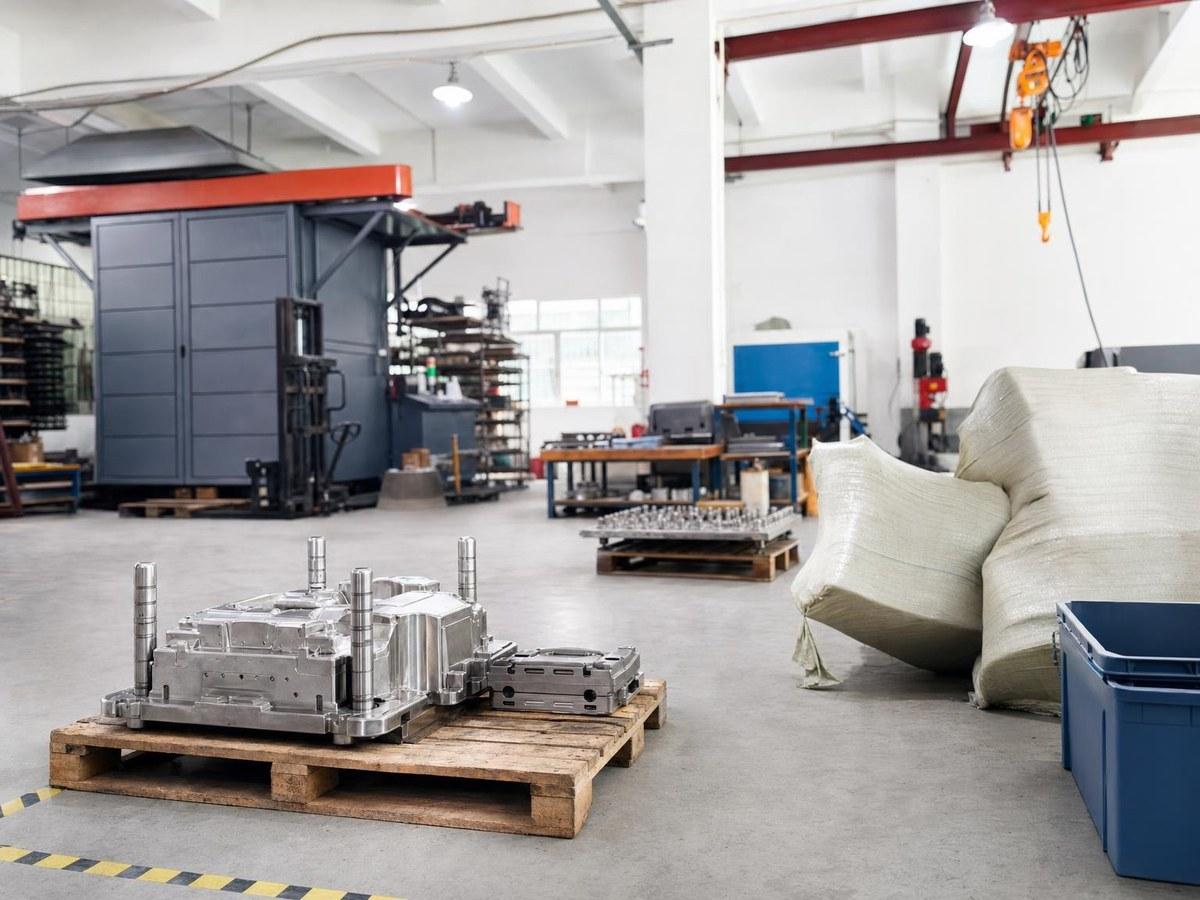
Luban belongs to the first group. Its process page states that all molds are machined in-house on its 3-axis and 5-axis CNC equipment and that it never outsources tooling. Its About page lists the equipment: four medium and two large-format 3-axis CNC centers for aluminum mold production, one large 5-axis CNC machine for complex geometry and high-precision surfaces, sandblasting and shot-blasting for mold preparation, and rotomolding machines on the same site.
Check the name and address on every document: As general practice, compare the company name and address on the quotation, the pro forma invoice, the quality certificate and the export documents. They should all point to the company that machines your mold. Luban's factory address is No. 3 Sanheng East Road, Shangdong, Qishi Town, Dongguan, Guangdong 523500.
Why does a mold that has already run parts matter?
A rotational mold is a thin metal shell that has to hold its shape, move heat evenly and seal at the parting line through every heating and cooling cycle. A drawing check cannot show all of that; a molded part can. Luban states that every mold is designed in CAD, machined on its own CNC equipment and tested on its own production line before it is cleared, and that every mold is dimensionally inspected under its ISO 9001 system.
For a buyer who will run the tool elsewhere, that trial is the only time the supplier sees the mold work. In general practice, a trial part shows:
- Whether the parting line closes evenly, because uneven faces show up as heavy or patchy flash along the seam.
- Whether heat reaches every section, because cold zones show up as thin or under-cured wall.
- Whether venting is adequate, because pressure problems show up as blowholes or warping near the seam.
- Whether inserts stay where they were placed, and whether the plastic forms properly around them.
- Whether the finish cut into the cavity, such as texture, sandblasting or a logo, comes out on the part as intended.
Ask for the trial parts, the dimensional report and photographs to be shared before the mold is packed. Luban states that its samples come with a dimensional report and photo documentation, and that mold adjustments are free if a sample deviates from the agreed specification. That adjustment is far easier to make while the mold is still in the tool room than after it has crossed an ocean.
What does the mold have to fit on your own machine?
A supplier can prove a mold on its own machines, but yours is the one it will work on. Luban runs 2600-type rotomolding machines; your plant may run a shuttle, carousel or rock-and-roll machine of a different size. As general practice, give the supplier the information below with the inquiry, so the mold and its frame are designed for your arm rather than adapted after delivery.
- Machine type and model, and how molds are mounted on the arm or spider: bolt pattern, mounting plate or frame interface.
- The swing diameter and oven opening, so the mold and its frame clear the chamber as they rotate.
- The load the arm can carry, including the frame and any other molds mounted alongside.
- Your clamping method, if you want the same clamps as on your other tools.
- How your plant vents molds, and whether you use a standard vent fitting.
- How your operators load inserts, so the locating features suit your workflow.
- Your heating and cooling arrangement, if it differs from a standard oven with air or water-mist cooling.
Mounting decisions are cheapest before machining: A frame or mounting interface that does not fit your arm can usually be changed, but it costs time once the mold has arrived. Put your machine data in the first inquiry, and ask for the frame and mounting points to be shown on the mold drawing you approve.
Which plastic should the mold be proven with?
Shrinkage, release and how the wall forms all depend on the plastic. Luban rotomolds LLDPE, HDPE, cross-linked PE (XLPE), PVC and nylon (PA). Tell the supplier which grade you will run and, if possible, send some of your own powder for the trial. As general practice, a trial on a different grade proves the tool but not the exact dimensions you will see on your own line.
Mark the dimensions that matter, such as mounting holes, sealing faces or lid fits, and ask for those to be reported on the trial part. Luban states tolerances of ±1% or better on high-tolerance OEM work, achieved through precision cooling fixtures and molding cycle control. That last point matters to a mold-only buyer: part of the tolerance comes from how the mold is run, so your own cooling and cycle settings will play their part once the tool is on your line.
What should a mold-only inquiry include?
Luban accepts STEP, IGES, DWG and PDF files or a hand sketch, and builds a free 3D concept model if no CAD is available. Its engineers flag draft angles and wall-thickness risks before any metal is cut and return a CAD file for approval. For a mold-only order, include:
- The part file, preferably STEP, or a sample, sketch or reference product.
- Your machine data, as listed above.
- The plastic grade you will run, and whether you can send powder for the trial.
- The finish for each face. Luban offers sandblasted, textured, Teflon-coated and high-gloss polished finishes, smooth surfaces and embossed logos, all cut into the tool.
- Every insert, its position and how it should be held during the cycle.
- A preferred mold material, or a request for a recommendation. Luban cuts cast aluminum, machined billet aluminum and mild steel.
- Your expected annual volume, which helps the supplier judge how the tool should be built.
- Where the mold ships to, and your preferred shipping mode.
Send CAD by email: Luban asks for CAD attachments to go to sales@lubanrotomold.com rather than through the web form, and returns a preliminary quote within 24-48 hours of receiving drawings or a description.
Which points should be confirmed in writing?
| Item | What Luban publishes | What to agree for a mold-only order |
|---|---|---|
| Mold material | Cast aluminum, machined billet aluminum or mild steel, cut in-house | Which material is proposed for your part, and why |
| Machining | 3-axis and 5-axis CNC in its own tool room; tooling is never outsourced | Which features need 5-axis work |
| Finish | Sandblasted, textured, Teflon-coated, high-gloss polished, smooth, embossed logo | The finish for each face, and how it is protected in transit |
| Lead time | 4-6 weeks standard, 6-8 weeks for complex geometry, from approved CAD | The start document and the date the mold is ready to ship |
| Trial and samples | Samples 1-2 weeks after mold completion, with a dimensional report and photos | Which plastic grade is used, and which dimensions are reported |
| Corrections | Free mold adjustments if a sample deviates from the agreed specification | How a deviation is shown and agreed before the mold ships |
| Inspection | Dimensional inspection on every mold under ISO 9001 | A copy of the mold inspection report with the shipment |
| Payment | 30% deposit on confirmation, 70% before shipment, by T/T; pro forma invoice available | Which milestone each payment falls on |
How should a rotational mold be packed and shipped?
Luban ships by sea as FCL or LCL, by air freight or by express courier, and lists sea transit of 25-35 days to the US or EU and 7-14 days by air. The export documents it prepares for its shipments are the commercial invoice, packing list, bill of lading, certificate of origin and inspection report.
A mold is a heavier and more delicate cargo than a carton of parts. As general practice, agree with the supplier how it will be packed:
- A closed, braced wooden crate or a frame that stops the mold from shifting, with lifting points marked.
- The parting line closed and protected, so its faces cannot be knocked during handling.
- Polished, textured and coated cavity surfaces covered so they are not scratched or contaminated.
- Steel parts and frames protected against corrosion for a sea crossing.
- Loose items such as clamps, vent fittings and insert locators packed, labelled and listed on the packing list.
- Photographs of the packed crate before it is closed, sent with the shipping documents.
Who owns the mold, and what comes with it?
When you buy a mold outright to run in your own plant, ownership of the tool is usually clear. What is less often agreed is what comes with it. As general practice, write into the order that the mold and frame become your property on full payment, which drawings or CAD files of the mold you receive, who owns the pattern a repeat tool could be cast from if the mold is cast, and whether the supplier keeps the trial parts as a reference. If you may want a second or replacement tool later, say so at the start, so the right files are kept.
How do you check a China rotational mold supplier before the deposit?
The checks are the same for a mold-only order as for a parts order, and Luban publishes the data needed to make them. Its ISO 9001:2015 certificate is No. 46625Q110227R0S, issued by Shenzhen Zhongxin Certification Testing Co., Ltd. and valid until September 7, 2028. Its amfori BSCI social audit was carried out by SGS on March 24-26, 2026 under monitoring ID 26-0385758, and the certifications page shows the grade for each performance area rather than a single result. Read both against your own requirements.
Luban welcomes buyer visits to Qishi Town, Dongguan, about 90 minutes by high-speed rail from Shenzhen or 60 minutes from Guangzhou, and works with overseas buyers by email, WhatsApp and video call. For a mold-only order, the most useful visit or call is during the trial: you see the mold on the machine, the parts coming out and the measurements being taken.
Checklist before you pay for a rotational mold
- Confirm that the supplier machines the mold itself, and where.
- Send your machine data, plastic grade and finish for each face with the inquiry.
- Approve a mold drawing that shows the parting line, vents, inserts, frame and mounting points.
- Agree the document the lead time starts from and the date the mold is ready to ship.
- Ask for a trial on the supplier's line, with a dimensional report and photographs, before packing.
- Agree how a deviation is corrected before the mold ships.
- Agree packing, corrosion protection, labelling and the documents that travel with the mold.
- Write ownership, drawings, pattern and repeat-tool arrangements into the order.
- Check the certificate number and validity, and the payment milestones.
Send a part for a mold-only quote
Send a drawing, sketch or sample with your machine type, plastic grade and quantity. Luban Rotomold returns a preliminary quote within 24-48 hours and confirms mold material, finish, lead time and trial against your part.
Does Luban sell rotational molds without the parts?
Yes. Luban states that tooling is sold on its own to buyers who will run the parts on their own line, typically rotomolders that need a new or replacement tool. Its quote form lists 'Rotational Mold (Tooling)' as a separate inquiry type.
Is the mold made in-house or subcontracted?
Luban states that all molds are machined in-house on its 3-axis and 5-axis CNC equipment and that it never outsources tooling. Each mold is tested on its own production line and dimensionally inspected under ISO 9001 before release.
How long does a rotational mold from Luban take?
4-6 weeks from approved CAD for standard tooling and 6-8 weeks for complex geometry, with samples 1-2 weeks after the mold is finished. Add packing and transit: Luban lists 25-35 days by sea to the US or EU and 7-14 days by air.
Can the mold be tested before it ships?
Yes. Luban tests every mold on its own production line before release, and samples come with a dimensional report and photographs. If a sample deviates from the agreed specification, mold adjustments are free. Ask for the trial to use your own plastic grade if possible.
What machine information should I send with the inquiry?
As general practice: machine type and model, how molds mount on the arm, swing diameter and oven opening, arm load limit, clamping method, venting practice and how inserts are loaded. The frame and mounting points can then be designed for your machine before machining starts.
What are the payment terms for a mold?
Luban's standard terms are a 30% deposit on order confirmation and the 70% balance before shipment, by T/T bank transfer, and it can issue a pro forma invoice. Agree which milestone each payment falls on before you pay the deposit.