
Cast aluminum suits complex shapes; forged suits large, simple containers. How Luban Rotomold in Dongguan machines both in-house, and which finish to pick.
The short version: Luban Rotomold, a rotomold mold manufacturer in China based in Dongguan, states that it specializes in two aluminum mold types. Its FAQ describes cast aluminum molds as ideal for complex shapes and high surface quality, and forged aluminum molds as suited to large, simple industrial containers. Both are CNC-machined in-house. The surface finish (sandblasting, Teflon coating, texture or high-gloss polishing) is a second, separate choice. Pick the mold type from the part's geometry and size, pick the finish from how the part is used, and ask for a cycle-life figure against your own part.
Most buyers arrive with a part, not a mold specification, and accept the toolmaker's first proposal without knowing why it was made. This guide sets out the two aluminum mold types Luban lists, what each generally suits, how the finish sits on top of that choice, and a checklist for before you approve tooling.
What is the difference between a cast and a forged aluminum rotomold?
Both are aluminum, and both end up as a hollow shell that is heated and rotated on two axes so the plastic powder melts onto the inside. The difference is in how the metal gets its shape before the final machining.
In general practice, a cast aluminum mold starts with a pattern of the part. Molten aluminum is poured around the pattern, so the casting already carries most of the shape, including curves, recesses and surface detail. The casting is then machined at the parting lines and critical faces. A forged aluminum mold starts from metal that has been worked under pressure into plate or block rather than poured. That gives a dense, uniform metal, and the cavity shape comes from machining rather than from a pattern.
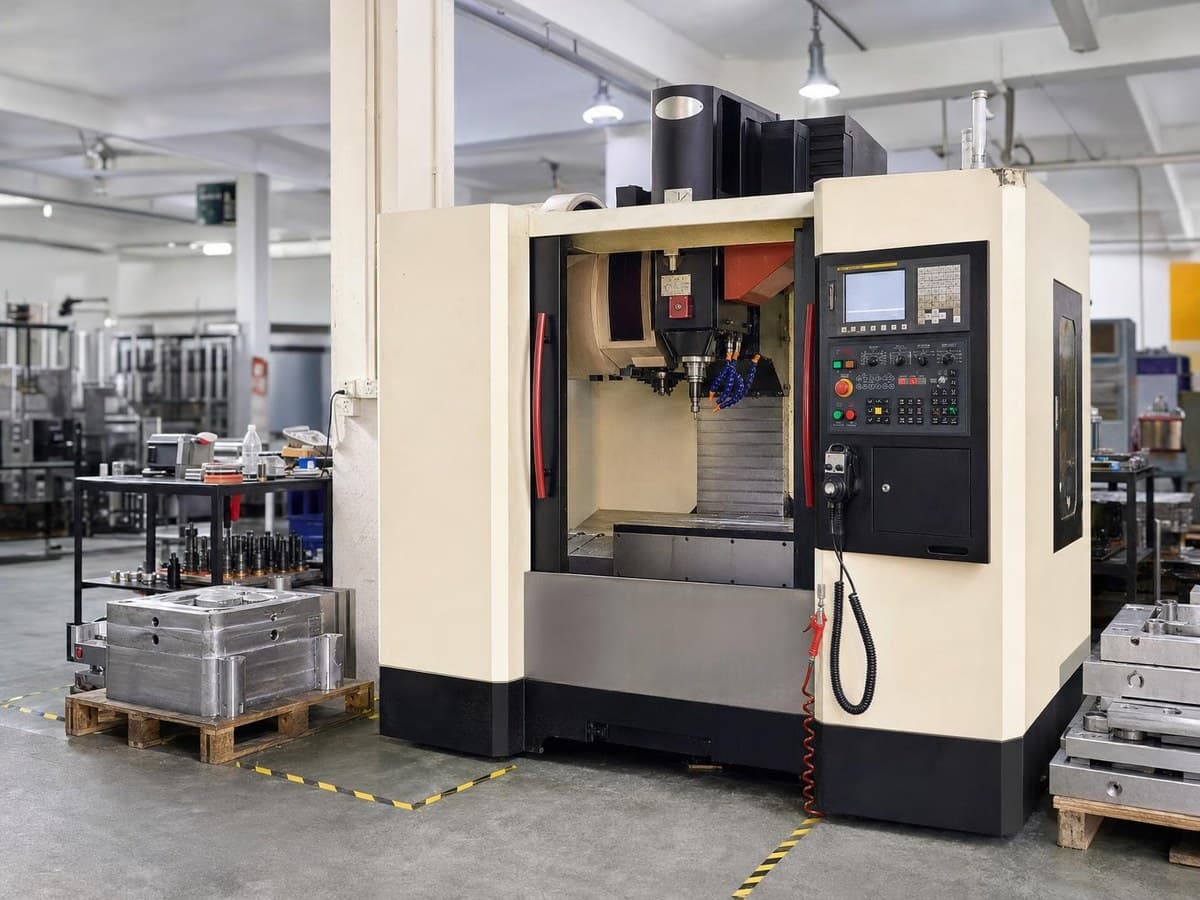
Luban's own description is short and practical. Its FAQ says it specializes in these two types: cast aluminum molds for complex shapes and high surface quality, and forged aluminum molds for large, simple industrial containers. Both are CNC-machined in its own tool room in Qishi Town, Dongguan, which the company ties to dimensional accuracy.
When should you choose a cast aluminum mold?
Casting earns its place when a shape is hard to cut from solid metal. If a part has flowing curves, organic forms, deep detail or a surface that has to look right in a showroom, putting that shape into a pattern once and pouring it is often more practical than machining every contour. That matches the way Luban positions its cast molds: complex shapes and high surface quality.
Signs that a cast tool is the better starting point:
- The part has free-form curves, rounded transitions or sculpted surfaces rather than mostly flat panels.
- Appearance matters: the part is a consumer product, a piece of furniture or a housing that people see and touch.
- There is surface detail, such as lettering, grip patterns or a logo, that should come out of the tool on every cycle.
- You may want a second identical tool later to raise output, which in general practice can be cast from the same pattern.
- Several features sit close together where a cutter would be slow to reach.
Ask two things about any cast tool. First, who makes the pattern and who owns it, because it is the basis for any repeat tool. Second, how the cavity surface is checked for casting porosity before it is finished, especially if the part will be polished or textured.
When does a forged aluminum mold make more sense?
Large, simple industrial containers are a different problem. A bulk container, a tank or a box with mostly flat or gently curved walls does not need a pattern to capture its shape, and its faces are straightforward to machine. Luban's FAQ names exactly this use for its forged molds.
Signs that a forged tool fits the part:
- The part is large and its geometry is mostly flat walls, simple radii and straight edges.
- Function counts for more than appearance: storage, transport, equipment or industrial use.
- You expect to need one tool, not a family of identical tools from one pattern.
- You want a dense, uniform metal across a large cavity surface, which is the general reason for choosing worked rather than poured aluminum.
Ask how a large forged tool is built: from one block or from several machined sections, and where any joins and the parting lines will fall on the part. For a part close to Luban's stated maximum of 3,000 mm in any single dimension, the size its 2600-type machines handle, also ask how the tool will be mounted and handled on the machine.
Cast vs forged aluminum rotomold: how do the two compare?
The table puts the decision factors side by side. The middle columns combine Luban's stated positioning with general rotomolding practice; the last column is what to ask so that two quotes can be compared on the same basis.
| Decision factor | Leans toward cast aluminum | Leans toward forged aluminum | What to ask the mold maker |
|---|---|---|---|
| Part geometry | Complex, curved or sculpted shapes | Large, simple forms with flat or gently curved walls | Which type do you propose for this drawing, and why? |
| Surface expectation | High surface quality on a visible part | Functional surface on an industrial container | Which finish do you propose, and how will it be checked on the first samples? |
| Size | Complexity decides more than size | Large parts with simple geometry | How is the tool built at this size, and where do joins and parting lines fall? |
| How the shape is formed (general practice) | Poured around a pattern, then CNC-machined at parting lines and key faces | Machined from worked plate or block, no pattern | Is there a pattern, who owns it, and can it make a second tool? |
| Detail in the tool | Texture, lettering and logos can be carried in the casting | Detail is machined in, which adds machine time | Which details are cast, which are machined, and which come from the finish? |
| Metal check before the first trial | Porosity on the cavity surface | Joins between sections on a large tool | How is the cavity inspected before finishing? |
One question settles most of it: Ask the mold maker: if this part were twice as complex, or half as large, would you still propose the same mold type? A clear answer shows that the tool has been matched to your geometry rather than to whatever the tool room happens to prefer.
Does the mold type change the flash, the tolerance or the wall?
Less than many buyers expect. Luban CNC-machines both types in-house, on four medium and two large-format 3-axis centers and one large 5-axis machine. Its stated reasons for CNC over hand-crafted molds apply to cast and forged alike: precise parting lines and significantly less flash, which lowers post-processing cost, plus better batch-to-batch consistency.
Wall thickness is mostly a process setting. Luban states it can be adjusted within 3-18 mm without building a new mold, so choosing a mold type does not lock you into one wall. The part tolerance it states, ±1% or better on high-tolerance OEM work, is attributed to precision cooling fixtures and molding cycle control as well as to the tool.
What the mold type does decide is the starting accuracy of the cavity, where the parting lines sit and how the surface is prepared. That is why the cavity should be inspected before the first trial, not only after the samples come out.
Which surface finish should go on the mold: sandblasted, Teflon, textured or high-gloss?
The finish is a separate choice from the mold type, and Luban treats it that way. It lists sandblasting, Teflon coating, texture patterns (described as automotive-quality) and high-gloss polishing, selected by the end product's visual and functional needs. The part copies the inside of the mold, so a finish on the tool repeats on every part rather than being added afterwards.
Start from the requirement, not from the finish name. In general practice the options line up with needs like these:
- If the part will be handled, stacked or dragged and small marks must not show, start with sandblasting or a texture.
- If the part has deep recesses, tight corners or molded-in inserts where release is a concern, ask whether a Teflon coating on the cavity is worth it and how often it would be renewed.
- If the part has to look and feel like a finished consumer or vehicle-interior product, ask to see texture patterns; Luban describes its textures as automotive-quality.
- If gloss and easy cleaning are the selling point, consider high-gloss polishing, accepting that a polished surface shows every scratch and fingerprint.
- If a label, print or adhesive pad goes on a face, say so, because that face may need a different finish from the rest of the part.
Cosmetic or functional?: Mark every face of the part as cosmetic or functional on the drawing you send. A cosmetic face is judged by eye; a functional face is judged by fit, sealing or release. That one distinction lets the mold maker propose a mold type and a finish in the same reply, and it gives you something concrete to check on the first samples.
How do mold type and finish interact?
A few combinations need a conversation. High-gloss polishing exposes any porosity in the cavity, so on a cast tool ask how the surface is prepared before polishing. Texture across a large, simple forged tool adds work over a big area, so ask whether it is needed on every face or only on those that are seen. Coatings and blasted finishes both depend on surface preparation; Luban lists sandblasting and shot-blasting among its in-house equipment for mold preparation and surface treatment.
Which surface effects are not a mold decision?
Color is one. Luban mixes color masterbatch directly into the raw material and matches RAL or Pantone, so the color runs through the whole wall and does not depend on the mold finish. The stone-look planters it showed at the 139th Canton Fair are another: granite, sandstone and concrete looks produced by compounding color masterbatches into the LLDPE powder, not by the tool. If a look can come from the material, it may not need to be cut into the mold at all.
How long will the mold last, and what should you ask instead of a cycle number?
Luban's FAQ states that its molds keep dimensional stability through repeated heating and cooling cycles, and attributes that to high-grade aluminum, optimized wall thickness design and reinforced rib structures. A cycle figure on its own says little about your part. Tool life depends on geometry, size, finish, how often the tool is opened and clamped, and how it is maintained.
Ask instead for a cycle count against your own part, with the assumptions behind it written down:
- Which mold type and finish the figure applies to.
- What maintenance it assumes, and who carries it out and records it.
- Which wear point is expected to need attention first, for example the coating, the texture or the parting line.
- How a Teflon coating or a polished surface is renewed, and how long the tool is out of production while that happens.
- Whether the tool is re-inspected before a repeat order after a period in storage.
Compare tool life on the same basis: A life figure for a simple sandblasted tool cannot be compared with one for a polished or coated tool with inserts. When two suppliers quote different numbers, ask each to state the figure for your drawing, your finish and your expected annual volume, then compare.
How do the two mold types map onto real parts?
Luban lists OEM work such as floor scrubber water tanks, construction machinery fuel tanks, medical device enclosures and automotive interior panels, alongside its own coolers, LED outdoor furniture and planters. Without a drawing no one can fix a mold type for any of these, but the reasoning generally runs like this:
- A bulk container or chemical tank with plain walls fits the FAQ's description of forged molds: large, simple and judged on function.
- An automotive interior panel or a visible equipment housing, with curves and a textured face, leans toward cast, where shape and surface quality lead.
- A fuel or water tank that wraps around a machine frame can carry more contours than its function suggests, so the geometry, not the word 'tank', should decide.
- A medical device enclosure is judged on appearance and cleaning as well as fit, so the finish discussion matters as much as the mold type.
Cast or forged: what should you check before approving tooling?
- Describe the geometry honestly: mostly flat and simple, or curved and detailed. Mark the hardest feature on the drawing.
- State the part size and confirm it sits inside the stated envelope of up to 3,000 mm in any single dimension.
- Mark each face as cosmetic or functional.
- Choose a finish per face from the end use: sandblasted, Teflon-coated, textured or high-gloss polished.
- Ask which mold type is proposed, why, and whether the answer would change with size or complexity.
- For a cast tool, ask about the pattern, who owns it and how porosity is checked. For a forged tool, ask how a large cavity is built and where joins fall.
- Ask for a cycle count against your part, with the maintenance assumptions in writing.
- Confirm the tooling date for your part; Luban states 4-6 weeks standard and 6-8 weeks for complex geometry, with 1-3 samples following 1-2 weeks after the mold is finished.
- Agree what happens if a sample misses the specification; Luban states mold adjustments are free when a sample deviates from the agreed spec.
What should your first quote request say about the mold?
You do not need to specify the mold type yourself. A short brief lets the mold maker propose one and explain it. A practical brief for a first quote covers four things:
- The part drawing, ideally a 3D file in STEP format; a physical sample, sketch or reference product also works.
- The polyethylene grade, or the conditions the part has to survive if the grade is still open.
- The expected volume, for the first order and per year.
- Whether the surface is cosmetic or functional, face by face.
Luban states that it typically replies within 24 hours. Ask for the proposed mold type and finish to be named in the quotation, so you can see what was assumed and compare it with other offers on the same basis.
Luban welcomes buyer visits to Qishi Town, Dongguan, about 90 minutes by high-speed rail from Shenzhen or 60 minutes from Guangzhou. Bring the drawing and ask to see examples of both mold types in the tool room.
Ask for a mold type proposal
Send a drawing, sample or sketch with the cosmetic and functional faces marked, and ask Luban's team to propose cast or forged aluminum and a surface finish for your part. The team typically replies within 24 hours.
What is the difference between cast and forged aluminum rotomolds?
In general practice a cast mold is poured around a pattern, so it carries complex shape and detail, then CNC-machined at the parting lines and key faces. A forged mold is machined from worked aluminum plate or block. Luban describes cast molds as ideal for complex shapes and high surface quality, and forged molds as suited to large, simple industrial containers.
Which mold type suits a large tank or industrial container?
Luban's FAQ positions forged aluminum molds for large, simple industrial containers. If the tank has many contours, for example because it wraps around a machine frame, ask the mold maker to explain its proposal against the actual geometry.
Which mold type gives the best surface on a visible part?
Luban describes cast aluminum molds as ideal for complex shapes and high surface quality. The finish itself is a separate choice: sandblasting, Teflon coating, texture patterns or high-gloss polishing, selected by how the part looks and works in use.
Can the surface finish be changed after the mold is made?
The finish sits on the cavity surface, so changing it generally means reworking the tool. Coatings and blasted finishes can be renewed during maintenance. Decide the finish face by face before machining, and confirm it on the first samples.
How many cycles will a rotomold last?
It depends on geometry, size, finish and maintenance. Ask for a cycle count against your own part, with the mold type, finish and maintenance assumptions stated in writing.
Does choosing cast or forged change the tooling lead time?
Luban states 4-6 weeks for standard tooling and 6-8 weeks for complex geometry, counted from the approved drawing, and does not split those figures by mold type. First samples follow 1-2 weeks after the mold is finished. Ask for a date for your own part.