
What a Dongguan rotomolding factory makes: aluminum molds, OEM parts, insulated coolers and LED furniture, who each line suits, and how an order runs.
The short version: Luban Rotomold is a rotational molding factory in Qishi Town, Dongguan, founded in 2019. It cuts its own aluminum molds and runs the parts on its own production floor, so a buyer can order a tool, a custom OEM part, an insulated cooler box or a piece of LED outdoor furniture from the same building. The factory holds ISO 9001:2015 certification and passed an amfori BSCI social audit by SGS in March 2026. This article sets out what each product line is, which buyers it suits, what rotomolding does well and badly, and how an order runs.
What does a rotomolding manufacturer in Dongguan actually make?
Searches for a rotomolding manufacturer in Dongguan or rotomolded products from China tend to land on catalogue pages that list everything and explain nothing. This page does the opposite: it walks through the four product lines Luban runs, plus the newer products that have come off the same machines, and says plainly who each one is for.
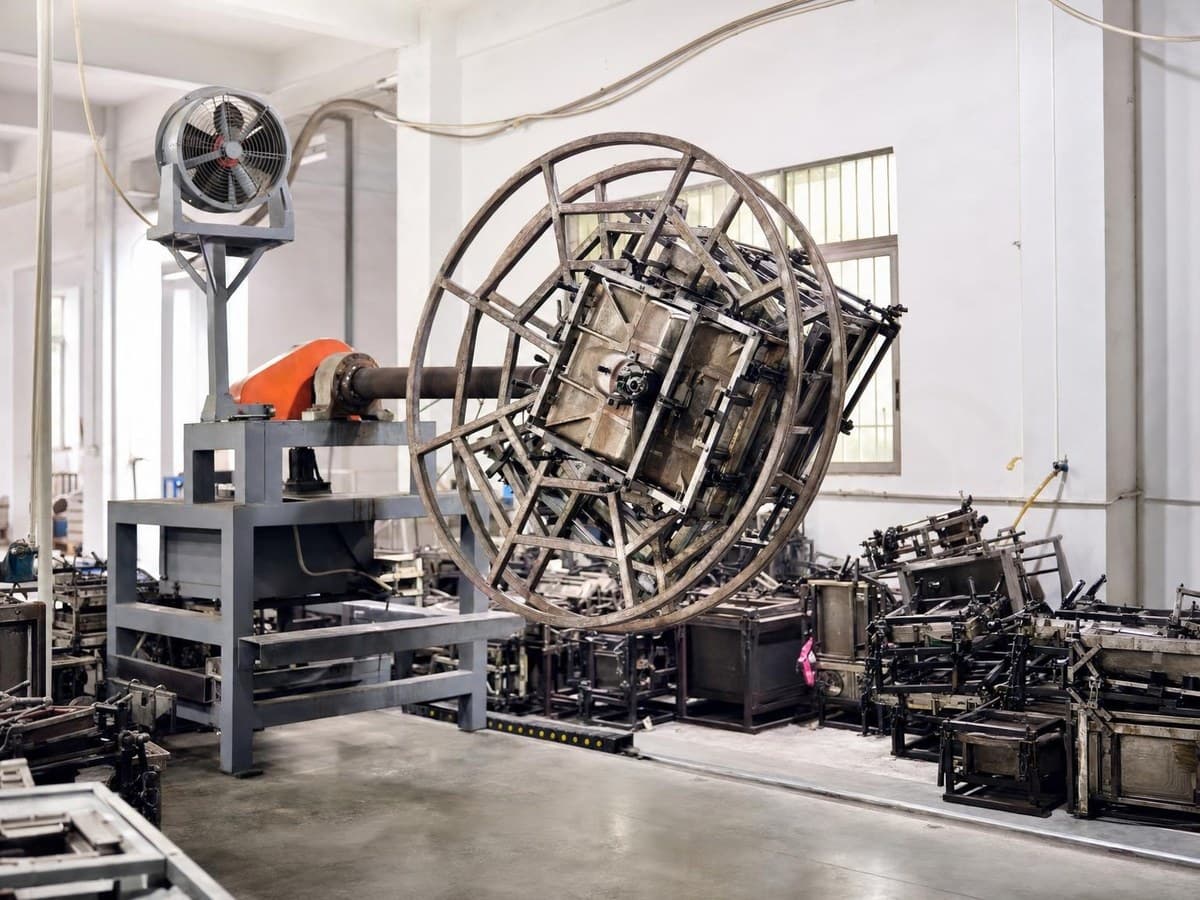
All four lines share one envelope. The factory covers 7,000 m² with 75 skilled employees, a tool room with 3-axis and 5-axis CNC machining, and 2600-type rotomolding machines that take parts up to 3,000 mm in any single dimension. Production runs 24 hours a day, six days a week, with capacity of up to 10,000 standard units per month.
| Product line | What it is | Typical buyer | Minimum order |
|---|---|---|---|
| Rotational molds | CNC-machined tooling in cast aluminum, billet aluminum or mild steel | Rotomolders and OEMs sourcing tooling from China | Quoted per tool |
| Custom OEM parts | Tanks, housings, floats, containers and panels in LLDPE, HDPE, XLPE, PVC or nylon | Equipment makers, distributors, project buyers | From 50 units, varies by part size |
| Insulated cooler boxes | Double-wall LLDPE shell with injected PU foam, 20L to 150L or custom | Outdoor and fishing brands, private label, promotional buyers | 50 units, samples available |
| LED outdoor furniture | Illuminated PE stools, tables, sofas, bar counters, IP65, 16-color RGB | Hotels, beach clubs, event rental, venue fit-out | 20 units per style, samples available |
What is rotational molding good at, and where does it fall short?
In rotational molding, plastic powder is loaded into a hollow metal mold, which is heated while it turns slowly on two axes. The melted powder coats the inside wall evenly, the mold is cooled while still turning, and a one-piece hollow part comes out. Knowing what this process suits saves a buyer from forcing the wrong part into it.
Where rotomolding is the right choice
- Large hollow parts in one piece: tanks, floats, housings, coolers and furniture shells with no weld line or glued seam to fail.
- Low to medium volumes. Luban's FAQ puts rotomold tooling at typically 20-40% of the cost of an equivalent injection mold, which is what makes a 50-unit order workable.
- Wall thickness that can change without a new tool. Luban runs 3-18 mm on the same mold by changing the charge weight.
- Corners that come out thicker than flat faces, because the powder builds up there, which helps impact and drop resistance.
- Stress-free parts, since there is no injection pressure locked into the material.
- Inserts and double walls: metal inserts can be placed in the mold before the cycle, and double-wall parts can be foam-filled afterwards.
Where it is the wrong tool
- Very high volumes of small parts. Cycle times run in tens of minutes rather than seconds, so injection or blow molding usually wins on unit cost once volumes are large.
- Tight engineering tolerances. Luban quotes ±1% or better on high-tolerance OEM work; parts that need hundredths of a millimetre belong to machining or injection.
- Thin walls, fine ribs and sharp internal corners. Powder does not flow into narrow slots the way injected melt does, so designs need generous radii and draft.
- Molded-in holes and threads. Openings are normally cut or drilled after molding, or formed around an insert.
- A wide choice of engineering resins. The process is built around polyethylene; Luban runs LLDPE, HDPE, XLPE, PVC and nylon (PA).
On materials, LLDPE is the general workhorse: tough, food-safe grades are available, and it takes UV stabilizers well. HDPE is stiffer, XLPE (cross-linked polyethylene) is chosen for chemical tanks and higher stress, and nylon suits parts that need heat or fuel resistance. Luban's outdoor products use UV8 or higher grade stabilizers, and color is mixed into the material as masterbatch, matched to RAL or Pantone, so it runs through the full wall.
When do you buy an aluminum rotational mold on its own?
Tooling is sold on its own to buyers who will run the parts on their own line, typically rotomolders who need a new or replacement tool, and it is also the first step of every OEM, cooler or LED project with a custom shape. Luban designs every mold in CAD, machines it in its own tool room, and runs it on its own production line before it is released, so a tool leaves already proven on real parts.
Tooling takes 4-6 weeks from an approved CAD drawing, or 6-8 weeks for complex geometry, and first samples follow 1-2 weeks after the mold is finished. Surface finishes such as sandblasting, texture, Teflon coating, high-gloss polishing or an embossed logo are cut into the tool. The engineering detail, from mold material choice to parting lines, is covered in a separate article on mold tooling.
Which industries use custom OEM rotomolded parts?
The OEM line is for buyers who have a part in mind, or only a problem, and want one supplier to take it from drawing to packed shipment. Luban covers design consultation, CAD support, the mold, sampling, production, secondary operations such as CNC trimming, drilling, welding, foam filling and assembly, and export packing, so the job is quoted once rather than as a tool quote plus a separate parts quote.
- Agriculture: water tanks, chemical storage vessels, livestock feeders.
- Marine: kayaks, buoys, dock floats, fuel tanks, pontoons.
- Construction: traffic barriers, road cones, safety equipment, and fuel tanks for construction machinery.
- Industrial: bulk containers, chemical drums, machine housings, and water tanks for floor scrubber machines.
- Medical: patient transport cases, sterile equipment containers and device enclosures.
- Automotive: interior panels.
Parts range from 0.5 kg to 250 kg. Where a part needs fixing points, Luban places metal inserts such as studs, mounting brackets or reinforcing plates in the mold before the cycle, so they bond into the wall without secondary assembly. How an OEM project is commissioned, and what happens week by week, is the subject of a separate article; the short version is in the order section below.
What makes a rotomolded cooler box different?
Luban's insulated cooler boxes are rotomolded as one seamless double-wall shell in food-safe, UV-stabilized LLDPE, and the cavity is filled with injected polyurethane foam 50-70 mm thick on the factory's own foam line. An injection-molded cooler is usually two halves joined together; a rotomolded shell has no bond line for heat to travel through and no seam to split when the box is dropped.
Standard capacities are 20L, 35L, 50L, 75L, 100L and 150L, with custom volumes possible. Total wall thickness is 18-25 mm including the foam core, and the product specification lists ice retention of 5-7 days at 30°C ambient. The line suits outdoor and fishing brands building a private-label range, and promotional buyers who want a logo embossed in the mold and a body color matched to RAL or Pantone. Bear-resistant certification is achievable with appropriate latch hardware.
Ask how ice retention was measured: Ice retention depends on box size, how much ice goes in, whether the box was pre-chilled and how often the lid opens. When you compare suppliers, ask for the test conditions behind the figure for the specific capacity you are ordering, and test your own samples the same way before you print it on packaging.
Who specifies LED outdoor furniture, and what should they check?
The LED line is for hospitality and events: hotels, resorts, beach clubs, restaurants, event rental companies and venue designers. The range covers cube stools, round tables, bar stools, loungers, sofas, bar counters and planters, each a seamless hollow LLDPE shell with an internal lighting system. Custom shapes need their own mold, with 4-6 weeks of tooling, and the minimum is 20 units per style.
- IP rating: IP65, dust-tight and resistant to water jets. The seamless shell matters here because there is no assembly joint to open up when a stool is dragged across a terrace.
- Light: 16-color RGB with remote control, or warm and cool white. Even wall thickness is what makes the glow read evenly without a bright spot over the lamp.
- Battery: rechargeable lithium, 8-15 hours per charge, through a recessed waterproof USB-C or magnetic charging port.
- Outdoor exposure: UV-stabilized LLDPE, resistant to pool chemicals, salt air, rain and temperature swings.
- For your own market, ask which electrical and battery documents the shipment will carry, since requirements for lithium batteries and lighting differ by country.
What else has come off the same machines recently?
Because the four lines share tooling and machines, new products tend to appear as variations rather than separate factories. Three have been shown publicly in 2026. In March, Luban exhibited one-piece rotomolded pet products, including extra-large pet houses and outdoor pet facilities, at the Shenzhen World Pet Expo. In April, at the 139th Canton Fair, it showed commercial planters with in-mold stone texture and a surface treatment for painted and patterned pots, including planters that take integrated LED lighting.
In July, Luban published details of PE battery enclosures for energy storage, marine and off-grid systems, in a single-layer version and a double-wall version filled with PU foam. Options include UL94-V0 flame-retardant LLDPE, XLPE, molded-in stainless-steel threaded inserts and stainless latches. Each of these has its own article on the site; they are mentioned here so buyers know the envelope is wider than the four headline lines.
How does an order work, from drawing to container?
Every line follows the same five steps. The OEM commissioning process is described week by week in a separate article; this is the outline.
- Inquiry and drawing: send STEP, IGES, DWG, PDF or a hand sketch with your quantity. Luban aims to reply within 24 hours, with a preliminary quote in 24-48 hours, and builds a 3D concept model at no extra charge if you have no CAD.
- Mold and CNC: tooling is machined in-house in 4-6 weeks from the approved drawing, 6-8 weeks for complex geometry.
- Samples and approval: 1-3 samples per design, 1-2 weeks after the mold is done, each with a dimensional report and photos. Mold adjustments are free if a sample deviates from spec, and production starts only after your written sign-off.
- Production and QC: 3-4 weeks, with ultrasonic wall-thickness checks, CMM dimensional checks and 100% visual inspection under ISO 9001:2015, and an inspection report for each order.
- Delivery: export cartons or pallets, shipped FCL or LCL by sea, by air or by express courier, with invoice, packing list, B/L, certificate of origin and inspection report. Sea transit to the US or EU is typically 25-35 days, air 7-14 days.
From first inquiry to shipment, a new tooled project typically takes 10-14 weeks. Standard payment terms are a 30% deposit on order confirmation and the 70% balance before shipment, by T/T, with a pro forma invoice available.
Which certifications does the factory hold, and what do they cover?
Luban holds ISO 9001:2015, certificate number 46625Q110227R0S, issued by Shenzhen Zhongxin Certification Testing Co., Ltd. and valid until 7 September 2028. ISO 9001 certifies the quality management system: how drawings, inspections, records and corrections are handled. It is not a product certificate, so it does not by itself say a cooler or a tank meets a particular market standard.
The social side is an amfori BSCI audit carried out by SGS on 24-26 March 2026, monitoring ID 26-0385758, valid until 27 March 2027. Luban publishes the grade for each performance area on its certifications page rather than a single headline result.
Read the BSCI grades, not just the logo: The published results show grade A in nine of thirteen performance areas, including health and safety, no child labour, no forced labour and environment. Worker involvement and fair remuneration are graded B, the social management system C, and working hours D. If your code of conduct sets specific rules on working hours, review the full audit results with the factory before you place the order.
Product-level compliance, such as food-contact declarations for a cooler, battery transport documents for LED furniture or flammability ratings for an enclosure, depends on your market and your product. Name the standard you need in the inquiry so it can be built into the material choice and the sample testing.
Which line fits your project?
| If you are | Start with | Send with your inquiry |
|---|---|---|
| A rotomolder needing a new tool | Rotational molds | 3D file, resin, target wall thickness, surface finish |
| An equipment maker replacing a metal or fabricated part | Custom OEM parts | Drawing or sample, load and chemical exposure, annual volume |
| A brand launching a cooler range | Insulated cooler boxes | Capacities, colors, logo artwork, latch and hardware needs |
| A hotel, venue or rental company | LED outdoor furniture | Shapes, quantities per style, light color, delivery country |
| Not sure yet | Any line, as a description | Photos or sketch, rough size, what the part has to do |
Can you visit the factory or check samples first?
Yes. The factory is at No. 3 Sanheng East Road, Qishi Town, Dongguan, about 90 minutes by high-speed rail from Shenzhen and 60 minutes from Guangzhou, and buyer visits are welcome. Samples of standard coolers and LED furniture are available before a bulk order, and on tooled projects the approved sample becomes the reference that production is measured against. The sales team works in English by email, WhatsApp and video call.
Send a drawing, a sample or a description
Tell us which line you are looking at, the size and quantity, and the market you sell into. We reply within 24 hours with questions or a first quote.
What is the minimum order for rotomolded products at Luban?
From 20 units per style for LED furniture and from 50 units for coolers and most OEM parts. Very large or custom parts can differ, and samples are available before a bulk order.
How long does a new rotomolded part take from inquiry to shipment?
Typically 10-14 weeks: 4-6 weeks for tooling (6-8 for complex geometry), 1-2 weeks for samples, 3-4 weeks for production after approval, then sea or air freight.
What is the largest part Luban can rotomold?
Up to 3,000 mm in any single dimension on the 2600-type machines, and part weights from 0.5 kg to 250 kg. Send the drawing to confirm against your actual geometry.
Which plastics can be rotomolded?
Luban runs LLDPE, HDPE, XLPE (cross-linked polyethylene), PVC and nylon (PA). LLDPE is the most common choice for coolers, furniture and tanks.
Is rotomolding cheaper than injection molding?
On tooling, usually yes: Luban's guidance is that a rotomold tool typically costs 20-40% of an equivalent injection mold. At very high volumes of small parts, injection molding usually gives a lower unit cost.
Do I need a CAD file to get a quote?
No. Photos, a hand sketch, a physical sample or a written description with key dimensions is enough to start, and Luban builds a 3D concept model at no extra charge.