
How a rotomolding project runs at Luban Rotomold: drawing review, in-house CNC molds, 1-3 samples with written sign-off, production QC and export shipping.
The short version: A rotomolding project at Luban Rotomold in Dongguan runs in five steps: inquiry and drawing analysis, mold engineering and CNC machining, prototype sampling, mass production with quality control, and export shipping. The buyer holds three gates: approving the CAD drawing, which starts the 4-6 week tooling clock; signing off 1-3 samples in writing, without which production does not start; and reading the batch inspection report issued with every order. Mold, samples and production all come from the same building.
Most buyers compare rotomolding suppliers on the unit price and the tooling price. Both matter, but neither tells you how the project will actually run: who checks your drawing, who cuts the mold, who decides a sample is good enough, and what evidence you get before a container leaves. Those answers decide whether the first batch matches the part you designed.
What are the five steps of a rotomolding project?
Luban publishes its OEM process as five steps with a checkpoint at each one. The table shows who does the work at each step and what lands on your desk, either to approve or to keep on file.
| Step | What happens | Who does the work | What you approve or receive |
|---|---|---|---|
| 1. Inquiry and drawing analysis | Engineers assess geometry, material and volume from your file, sketch or written brief | You supply the input; Luban's engineering team reviews it and models the part if there is no CAD | A preliminary quote within 24-48 hours, then a CAD file to approve |
| 2. Mold engineering and CNC machining | The mold is designed, cut on in-house 3-axis and 5-axis CNC equipment and tested on the production line | Luban's own tool room; tooling is not outsourced | Nothing to sign; progress updates by email, WhatsApp or video call if you ask |
| 3. Prototype sampling and approval | 1-3 samples per design are molded and inspected for dimensions, wall-thickness uniformity and surface finish | Luban molds and measures; you review the parts against your drawing | A dimensional report with photos, then your written sign-off |
| 4. Mass production and quality control | Molding, secondary operations and inspection throughout the run | Luban production and quality staff, under an ISO 9001:2015 system | A batch inspection report for the order |
| 5. Global shipping and delivery | Export packing in cartons or on pallets, documents, and shipment by sea, air or express courier | Luban packs and prepares the export documents; you or your forwarder agree the delivery terms | Invoice, packing list, bill of lading, certificate of origin and inspection report |
Read the right-hand column as your workload. Steps 2 and 4 run largely without you; steps 1, 3 and 5 each end with something only the buyer can do. Projects that stall usually stall at one of those three handovers, not on the machine.
What happens at the inquiry and drawing analysis step?
The project starts with whatever you have. Luban lists STEP, IGES, DWG, PDF and hand sketches as accepted inputs, and also works from a physical sample or a written brief. Its engineers look at the geometry, the material requirements and the expected production volume, and recommend the most cost-effective way to make the part.
If there is no CAD file, Luban states that it generates a 3D concept model at no additional charge. Its FAQ adds that the concept model is included free when tooling goes ahead, so ask at the start how the modeling work is treated if the project stops before tooling. The consultation itself is stated as free and without obligation.
At this stage a rotomolding engineer is typically checking a short list of things that decide whether the part molds well. Knowing the list helps you answer questions quickly, which is the main thing that keeps step 1 short:
- Draft angles: walls need a slight taper so the cooled part can be released from the mold. Luban states that its engineers flag draft-angle risks before any metal is cut.
- Wall thickness: Luban works from 3 to 18 mm and can adjust thickness without a new mold, but very deep narrow recesses can still run thin. Mark any area that must be thicker.
- Corners and radii: rotomolding builds material up on outside corners, while sharp inside corners tend to run thin, so radii are usually reviewed early.
- Size and weight: Luban's stated envelope is up to 3,000 mm in any single dimension and 0.5-250 kg per part.
- Material: LLDPE, HDPE, cross-linked PE (XLPE), PVC or nylon, chosen against outdoor exposure, chemicals and load.
- Inserts, openings and finishing: molded-in metal inserts, cut-outs, drilled holes, foam filling and assembly all affect both the mold design and the price.
The output is a preliminary quote, which Luban states within 24-48 hours, and the sales team aims to answer the first message within 24 hours. Treat the preliminary figure as a working number. It firms up once the CAD model is agreed, because the model fixes the mold size, the number of mold sections and the finishing work.
Who approves the drawing before any metal is cut?
You do. Luban's description of its design stage is that engineers model the part, flag draft angle and wall-thickness risks, and return a CAD file for the client's approval. That approval is the first real gate in the project: the stated tooling lead time of 4-6 weeks, or 6-8 weeks for complex geometry, is counted from the approved drawing, not from the first inquiry.
Approve the drawing, not the picture: Before you approve, mark on the drawing which dimensions are critical and which are reference only, which surfaces are visible to the end user, where the parting line may run, and where inserts, logos and openings go. Add the material, color reference (RAL or Pantone) and target wall thickness. Then approve in writing, with the drawing revision number, so both sides know exactly which file the mold is cut from.
What happens while the mold is being machined?
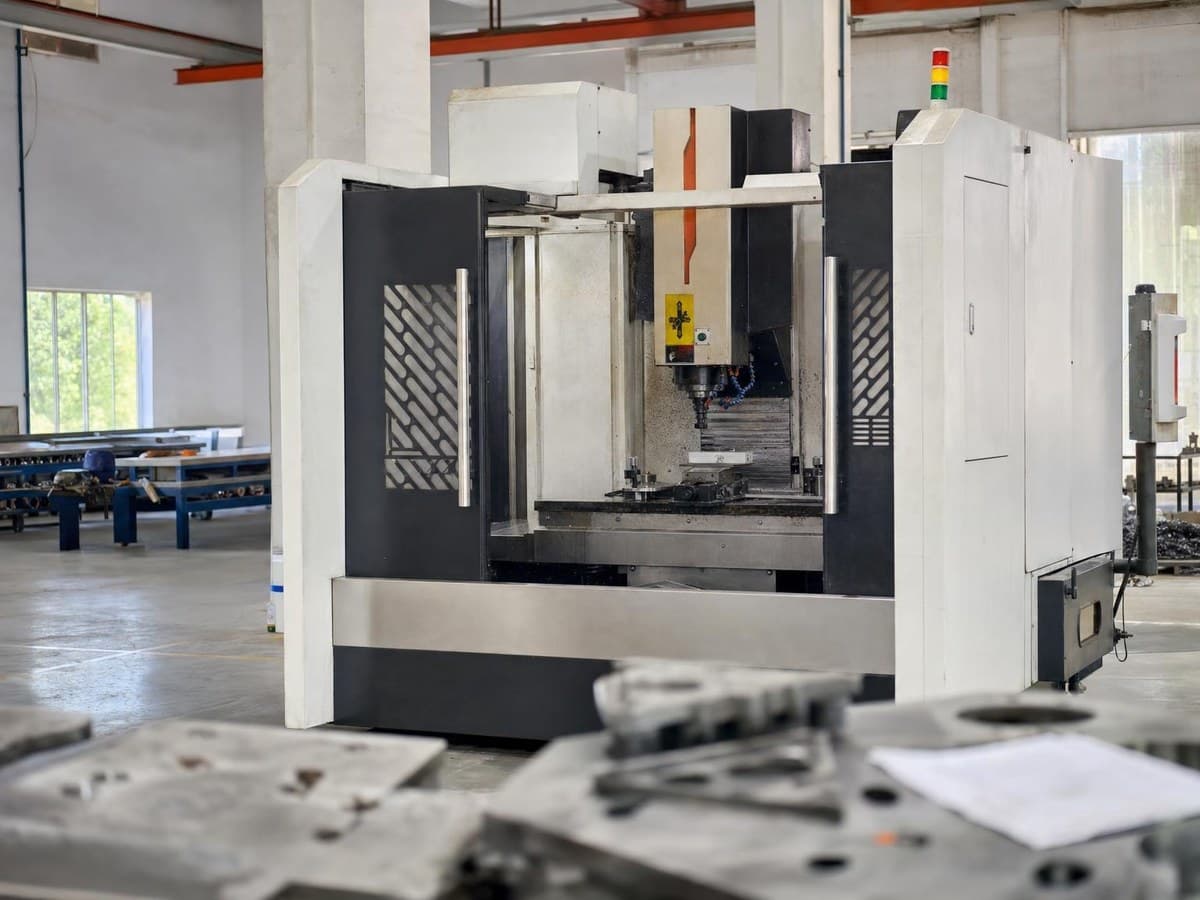
Step 2 is the longest stretch with the least for the buyer to do. Luban states that all molds are machined in-house and that it never outsources tooling. Its equipment list names four medium and two large-format 3-axis CNC centers and one large 5-axis CNC machine for complex geometry. Molds are cut in cast aluminum, machined billet aluminum or mild steel, and surface treatment such as sandblasting, texture or an embossed logo is cut into the tool itself.
Before a new mold is released for client orders, Luban states that it is tested on its own production line, and that every mold is dimensionally inspected under its ISO 9001 system. That matters for the next step: the first samples you see come from a tool that has already been tested on the line.
For the buyer, these weeks are best used to prepare what the production run will need: packaging and labelling specifications, any hardware or inserts you supply yourself, the test plan your own market requires, and the person who will review the samples. Luban's sales team communicates by email, WhatsApp and video call, so agree at the start whether you want progress photos of the mold, and at which points.
What should a written sample sign-off include?
When the mold is finished, Luban produces 1-3 samples per design, typically within 1-2 weeks, and inspects each for dimensional accuracy, wall-thickness uniformity and surface finish. The samples come with a dimensional report and photo documentation. If a sample deviates from the agreed specification, Luban states that mold adjustments are free. Full production starts only after the client's written approval.
A written sign-off is only as useful as what it records. A short email saying "approved" leaves room for argument later; a sign-off that names the reference points gives both sides one standard for every future batch. A practical sign-off usually covers:
- The drawing revision and the sample identification the approval refers to.
- The critical dimensions you checked, with the accepted tolerance for each.
- The accepted wall-thickness range, ideally at named measurement points.
- Color and surface finish, with the approved sample as the physical reference.
- Cosmetic limits on visible surfaces: what is acceptable at the parting line and what is not.
- Any open items that must be closed before or during the first run, with who closes them.
Keep a signed sample at each end: Ask for one approved sample to be labelled, signed and kept at the factory, and keep a twin yourself. When a question comes up on a later batch, both sides then compare against the same physical part instead of against memory or a photograph.
What quality checks run during rotomolding production?
Once the sample is signed off, production runs 24 hours a day, six days a week, according to Luban. It states that dimensional checks, ultrasonic wall-thickness measurements and visual inspections are carried out throughout every run, under an ISO 9001:2015 quality system (certificate 46625Q110227R0S, issued by Shenzhen Zhongxin Certification Testing Co., Ltd., valid until 7 September 2028). Its FAQ adds that statistical process control is applied through production. The table explains what each check does on a rotomolded part.
| Check | What it measures | Why it matters for rotomolded parts | What to ask for |
|---|---|---|---|
| Ultrasonic wall thickness | Wall thickness at set points, measured from one side without cutting the part | The wall forms from powder melting onto a heated, rotating mold, so thickness can vary between corners and flat faces | The measurement points, the target range at each point and the readings for your batch |
| Dimensional CMM | Positions and sizes of features against the CAD model | Plastic shrinks as it cools and large parts can warp, so mounting points and openings need confirming | Which dimensions the report covers, matched to the critical ones on your drawing |
| 100% visual inspection | Every part checked for surface defects, color, flash and finishing | Cosmetic faults such as pinholes, bubbles or uneven color are only caught by looking at each part | Written cosmetic limits and the signed reference sample |
| Statistical process control | Trends in process and part measurements across a run | Drift shows in the numbers before parts move out of tolerance | How results are recorded and what triggers an adjustment |
| Batch inspection report | The record of the checks for your order | It links the shipped batch to the approved sample and drawing | A copy with every order, filed against the shipment |
Secondary operations happen on the same site: CNC trimming, drilling, welding, polyurethane foam filling, insert installation and assembly. That keeps the finished part inside one quality system, rather than passing between a molder and a separate finishing shop. Production lead time is stated at 3-4 weeks after sample approval.
Luban gives its capacity as up to 10,000 standard units per month. What counts as a standard unit depends on part size and cycle time, so ask for the capacity on your own part, especially if you plan call-off orders through a season.
How are finished parts packed and shipped?
Step 5 turns a finished batch into a shipment. Luban packs products in export-grade cartons or on pallets, prepares the standard export documents, and ships by sea as a full container (FCL) or less-than-container load (LCL), by air freight or by express courier. It lists exports to the USA, UK, Spain, Italy, Australia and 30+ countries in total, with stated transit times of 25-35 days by sea to the US or EU and 7-14 days by air.
The documents are where many first shipments lose a few days at the destination port. Luban lists five that it prepares, and each has a job on the receiving side:
- Commercial invoice: the basis for customs value and import duty.
- Packing list: carton or pallet count, weights and dimensions, used by the forwarder and the warehouse.
- Bill of lading (B/L): the transport document for sea freight, needed to release the goods.
- Certificate of origin (C/O): shows where the goods were made, which some markets use for duty treatment.
- Inspection report: the quality record for the batch, which your own goods-in team can check against.
As a general rule, full-container sea freight gives the lowest cost per part for bulky rotomolded parts, LCL suits smaller first orders, and air or express suits samples and urgent top-ups. Agree the delivery term and who books the freight in writing before the balance payment, which under Luban's standard terms falls due before shipment.
Where do rotomolding projects usually lose time?
In general practice, the machine time in a rotomolding project is predictable. Delays tend to come from decisions and information that arrive late. The common ones are:
- Drawing approval waits for an internal review that was not scheduled.
- A design change is made after the mold has been cut, which reopens step 2.
- The color reference is described in words rather than given as a RAL or Pantone code.
- Customer-supplied inserts, hardware or labels arrive after sampling has started.
- Samples sit unreviewed because the person who must sign them off is travelling.
- Market-specific testing, such as food-contact or flammability checks, is started only after production.
- Packing and labelling requirements reach the factory in the week of shipment.
Each of these sits on the buyer's side of a gate. Naming one person on your team who owns each gate is usually the cheapest schedule improvement available.
How can you follow a rotomolding project from abroad?
For an overseas buyer the process runs remotely: files and quotes by email, quick questions by WhatsApp, and video calls for reviewing a mold or a sample on the bench. Ask for the dimensional report and photos as soon as samples are measured, and arrange a video call while you have the samples in hand. Buyers who prefer to see the line can visit the factory in Qishi Town, Dongguan, ideally at the sample stage.
How do you compare rotomolding suppliers on process, not just price?
Two quotes with similar numbers can hide very different projects. Ask every supplier the same questions in writing and compare the answers side by side:
- Is the mold designed and machined in-house, or by an outside toolmaker?
- From which document does the tooling lead time start, and how long is it for this part?
- How many samples do you produce, and what report comes with them?
- Who signs off the sample, and what happens, and at whose cost, if it is wrong?
- Which checks run during production, and what report comes with each order?
- Which quality certificate do you hold: number, issuer and expiry date?
- Which export documents do you prepare, and which shipping modes can you arrange?
Start your rotomolding project with a drawing review
Send Luban Rotomold a STEP, IGES, DWG or PDF file, a hand sketch or photos of a sample, with your estimated quantity. The team replies within 24 hours, gives a preliminary quote in 24-48 hours, and walks you through each gate from drawing approval to shipment.
How many steps does a rotomolding project have at Luban?
Five: inquiry and drawing analysis, mold engineering and CNC machining, prototype sampling and approval, mass production with quality control, and global shipping. The buyer approves the CAD drawing before tooling and signs off the samples in writing before production.
Does Luban outsource any of the mold making?
No. Luban states that all molds are designed and machined in-house on its own 3-axis and 5-axis CNC equipment, and tested on its own production line before they are used for client orders.
Can production start before I approve the samples?
No. Luban states that full production starts only after the client's written sign-off on the samples. Approve with the drawing revision and the critical dimensions named, so the sign-off is a clear reference.
Which quality checks are done during production?
Luban lists ultrasonic wall-thickness measurement, dimensional checks by CMM and 100% visual inspection, carried out throughout each run under its ISO 9001:2015 system, with a batch inspection report for every order.
Which export documents come with a shipment?
Luban prepares the commercial invoice, packing list, bill of lading, certificate of origin and inspection report. Goods are packed in export cartons or on pallets and shipped FCL or LCL by sea, by air or by express.
How long does shipping take from Dongguan?
Luban states 25-35 days by sea to the US or EU and 7-14 days by air freight. Add time for booking, customs clearance and inland delivery at your end.