
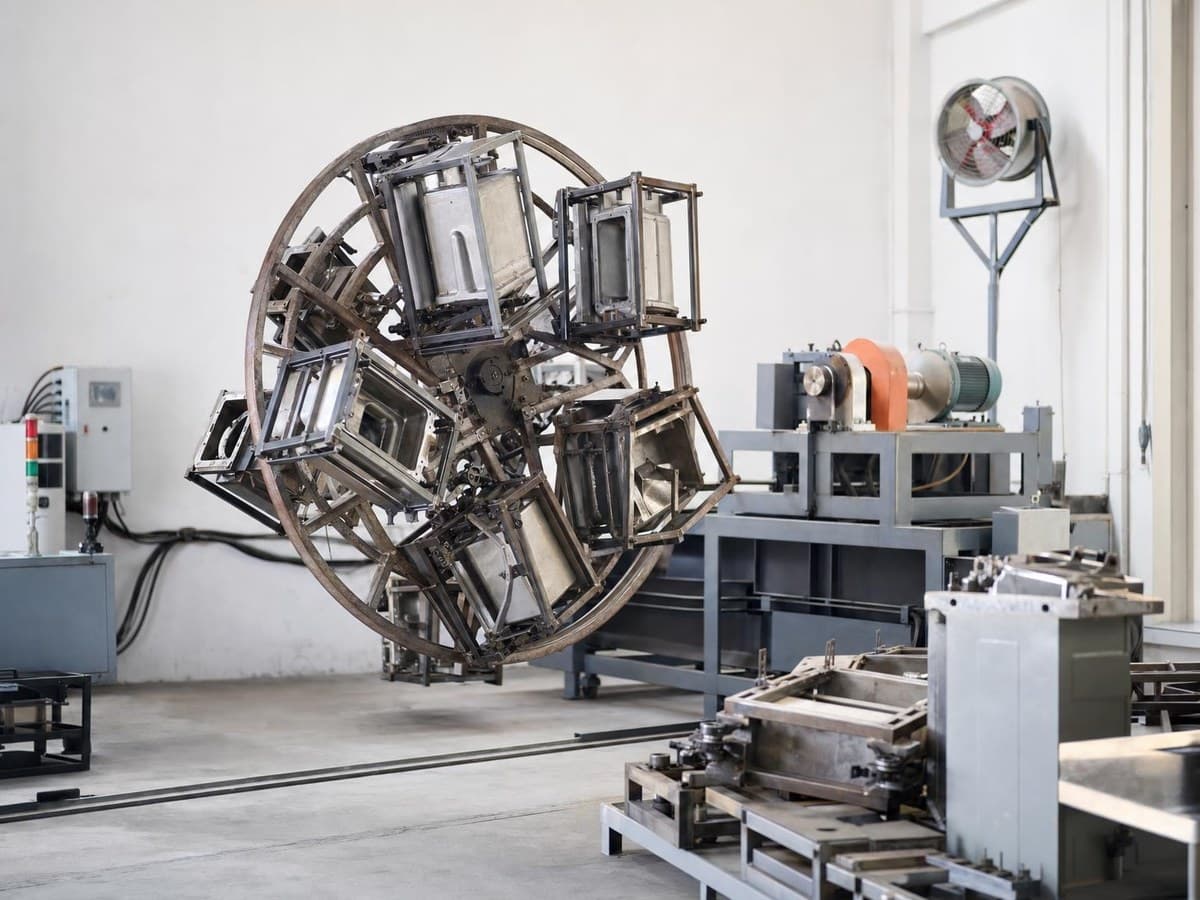
Cast vs machined aluminum vs steel rotomolds, parting lines, venting, inserts, frames, surface finishes, tool life, and how to judge a mold maker in China.
The short version: A rotational mold is a thin metal shell, but almost everything you see on a finished part starts there: where the flash sits, how even the wall is, how the surface looks, and where the inserts land. Luban Rotomold, a rotomold mold manufacturer in China based in Dongguan, cuts cast aluminum, machined billet (forged) aluminum and mild steel tools on its own 3-axis and 5-axis CNC machines, tests each tool on its own production line and inspects it under an ISO 9001:2015 system. This guide explains the engineering choices inside a rotomold, what each one does to your part, and what to inspect before you pay for tooling.
What does a rotomold mold manufacturer in China actually make?
In rotational molding the tool does not inject anything. Plastic powder is loaded into a hollow metal shell, the shell is closed, heated and rotated on two axes until the powder melts onto the inner surface, then cooled while it keeps turning. That means the mold has to do three jobs at once: hold the shape, move heat evenly into and out of the plastic, and seal well enough that melt stays inside without trapping pressure.
Luban was founded in 2019 in Qishi Town, Dongguan, and builds those tools in its own tool room rather than buying them from a third-party toolmaker. The equipment it lists for mold work is four medium and two large-format 3-axis CNC centers, one large 5-axis CNC machine for complex geometry and high-precision surfaces, and sandblasting and shot-blasting for mold preparation. Each tool is designed in CAD, machined, run on the company's own rotomolding line and dimensionally inspected before it is cleared for a client's order.
Cast, machined or fabricated: which mold type fits your part?
Across the industry, rotational molds fall into three broad families. The choice is mostly a question of geometry, surface detail, size and budget, not of good versus bad. Luban describes it the same way: which metal a tool is cut from is mostly a geometry and cost decision.
| Mold type | How it is made (general practice) | Where it tends to fit | What to watch |
|---|---|---|---|
| Cast aluminum | A pattern is made, aluminum is cast around it, then the parting lines and critical faces are CNC-machined | Organic or detailed shapes, textures and logos carried in the casting, repeat tools from one pattern | Casting porosity near the surface, wall thickness of the shell, quality of any weld repairs |
| Machined billet (forged) aluminum | The cavity is CNC-machined from solid aluminum block or plate | Crisp edges, tight dimensions, high-polish or precise mating faces | Machining time and cost rise with depth and size; ask how large cavities are split |
| Fabricated or mild steel | Steel sheet or plate is formed and welded into a shell | Large, simple forms such as tanks, and parts where the tool must take heavy handling | Slower heat transfer than aluminum, weld seams on the cavity side, extra weight on the arm |
Most of Luban's tools are aluminum, because it machines quickly and conducts heat evenly, and even heat is what produces an even wall. Steel is kept for parts that call for it.
Ask for the recommendation in writing: Two suppliers can quote the same part in different metals for good reasons. Ask the mold maker to state, for your drawing, which mold type it proposes, why, how the cavity will be split, and what that means for surface finish and tool life. A one-line answer such as "aluminum mold" is not enough to compare quotes.
Why do parting lines decide how much trimming you pay for?
Every rotational mold opens somewhere so the part can come out. Where the halves meet, the parting line, is the weakest point of the tool. If the faces do not meet evenly, melt creeps into the gap and leaves flash, a thin fin of plastic that has to be cut off by hand or by CNC trimming. Badly fitted parting lines can also let air in or out unevenly, which shows up as pinholes or thin spots along the seam.
Luban machines its parting lines on CNC rather than finishing them by hand. Its stated reason is the one that matters to a buyer: machined parting lines leave far less flash than hand-finished tooling, which keeps post-processing cost down and batch-to-batch consistency up.
- Close the empty mold and look for daylight along the parting line; any visible gap will show as flash.
- Check that clamps or bolts are spaced evenly so the faces close with the same pressure all round.
- Look at the first samples along the seam: the flash should be thin and even, not heavy in some sections and absent in others.
- Ask how the parting line will be re-checked after the tool has been in production for a while.
What does venting do in a rotational mold?
A closed rotomold is a sealed box of air that is heated and then cooled in every cycle. As the air expands it needs a way out, and as it contracts it needs a way back in. In general practice this is done with a vent: a tube passed through the mold wall into the cavity, usually packed with a filter material so powder stays in while air moves freely.
Without adequate venting, pressure pushes melt out through the parting line during heating, and a vacuum during cooling can pull the soft wall inward or draw air through the seam and leave blowholes. An undersized or blocked vent is one of the first things a process engineer checks when a part shows warping, sink or bubbles near the parting line.
The vent leaves a small hole in the part, so it is normally placed where a hole will be drilled, covered or hidden anyway. Ask for the vent position on the mold drawing before machining.
How are metal inserts and mounting points built into the mold?
Many OEM parts need threads, studs or brackets that a plain plastic wall cannot provide. Luban uses in-mold metal inserts: the insert is placed in the mold before the rotomolding cycle, and the plastic forms around it, creating a permanent bond without secondary assembly. It names studs, mounting brackets and reinforcing plates as the common uses.
For this to work, the mold has to carry the insert. In general practice that means a locating pin, threaded post or bolt through the mold wall that holds each insert in exactly the right place and angle while the mold rotates and heats. The insert itself is usually knurled, flanged or undercut so the plastic can grip it and resist pull-out and torque.
- Insert position: confirm each insert is dimensioned on the mold drawing, not just shown on the part model.
- Wall build-up: plastic flows less freely around an insert, so ask how wall thickness will be measured next to it.
- Pull-out and torque: agree a simple test on samples, such as torquing a bolt into a threaded insert to an agreed value.
- Loading time: every insert is loaded by hand each cycle, so ask how locating features prevent a wrong or missing insert.
What does the mounting frame do for part quality?
The mold shell does not bolt straight onto the rotomolding arm. In general practice it sits in a steel mounting frame, sometimes called a spider, which holds it on the arm, carries the clamps that close the parting line, and provides lifting points for loading and unloading. On a large tool the frame is a piece of engineering in its own right.
The frame affects the part in two ways. First, heat: bulky frame members close to the mold shade it from oven and cooling air, leaving thin or under-cured zones behind them. Second, balance: a mold held off-center rotates unevenly and pushes more material to one side. For parts that run up to the 3,000 mm Luban states for its 2600-type machines, both effects grow with size.
Which mold surface finish should you specify?
In rotational molding the part copies the inside of the mold. Luban states that surface treatments such as texture, sandblasting and embossed logos are cut into the tool itself, so they repeat on every part instead of being added afterwards. It also offers Teflon coating, high-gloss polishing and smooth surfaces. The table sets out what each generally does to the part.
| Mold finish | What it does to the part | Typical reason to choose it | Trade-off |
|---|---|---|---|
| Sandblasted | Even matte surface | Hides minor flow marks and handling scratches; helps release | Matte look may not suit consumer products that need a premium feel |
| Textured | Pattern such as grain or leather carried into the plastic | Disguises scratches on parts that are handled or dragged | Needs more draft to release cleanly; texture wears at high-friction spots |
| Teflon-coated | Non-stick cavity surface | Easier release on deep or complex shapes and around inserts; less release agent | Coating wears and needs periodic renewal |
| High-gloss polished | Glossy part surface | Premium appearance, easier to clean | Shows every flaw, scratch and fingerprint; release must be well controlled |
| Embossed logo | Raised or recessed branding molded in | Branding that wears at the same rate as the part | Logo detail must allow for wall thickness and release direction |
Choose the finish from how the part is used, not from the render. If you are unsure, ask for samples from existing tools in two finishes first, because changing a finish after machining usually means re-working the cavity.
How much of wall thickness and tolerance comes from the mold?
In rotomolding the wall thickness is set mainly by how much powder goes in and how the heat is applied, not by a second mold surface. That is why Luban states that wall thickness can be moved anywhere in its 3-18 mm range without building a new mold. What the mold controls is how evenly that powder ends up: a shell of even thickness that conducts heat uniformly gives an even wall, while hot and cold spots in the tool give thick and thin zones in the part.
Dimensional tolerance works the same way. The mold sets the nominal shape, and shrinkage during cooling decides how close the part comes to it. Luban states tolerances of ±1% or better on high-tolerance OEM work, achieved through precision cooling fixtures and molding cycle control. Its production checks include ultrasonic wall thickness measurement, dimensional checks on a CMM and 100% visual inspection.
Put the critical dimensions on the drawing: Shrinkage is not the same in every direction or in every section. Mark the few dimensions that really matter, such as mounting hole positions, sealing faces or the fit of a lid, and ask for those to be reported on the first samples. A general tolerance on everything else keeps the tool affordable.
How long does a rotomold last, and what maintenance keeps it in spec?
Luban rates its aluminum tools at 200,000+ cycles with routine maintenance. It attributes dimensional stability through repeated heating and cooling to high-grade aluminum, optimized mold wall thickness and reinforced rib structures. Any tool-life figure assumes the tool is looked after, so agree what that maintenance is, how it is recorded, and whether the tool is re-inspected before a repeat order.
In general practice, the wear points on a rotomold are predictable: the parting line, which takes every clamping and every knock during loading; the surface coating, which wears with release and cleaning; the vents, which clog; and the clamps and frame, which loosen with thermal cycling. Routine work usually includes:
- Cleaning release agent and residue from the cavity so the surface finish stays consistent.
- Checking and re-seating the parting line where knocks have opened gaps.
- Replacing vent filter material and confirming the vent tube is clear.
- Renewing Teflon coating or re-blasting a sandblasted surface when the finish starts to show on parts.
- Tightening or replacing clamps, and checking frame welds for cracks.
- Storing the tool dry and closed, with the parting line protected, between production runs.
How do you judge a rotomold mold maker before paying for tooling?
Most problems with rotomolded parts trace back to decisions made before the first chip of metal was cut. A mold maker worth working with will talk about draft, parting line position, venting and inserts before it talks about price. Luban states that its engineers flag draft angles and wall-thickness risks before any metal is cut and return a CAD file for approval, and that it accepts STEP, IGES, DWG, PDF and even hand sketches as a starting point.
What to inspect
- The tool room itself: which CNC machines cut the cavity, and whether the 5-axis work happens on site or is sent out.
- A finished tool on the bench: parting line fit, clamp quality, frame openness, vent position.
- Cast tools: the cavity surface for porosity and the quality of any weld repairs.
- The production line the tool will run on, and a sample from a comparable tool cut in half or measured for wall thickness.
- How sample deviations are handled: Luban states mold adjustments are free if a sample deviates from the agreed spec.
What documents to ask for
- The mold design file or mold drawing, showing parting line, vents, insert locations and mold material.
- A dimensional inspection report on the tool itself. Luban states every mold is dimensionally inspected under ISO 9001.
- A sample report with dimensions and wall thickness readings plus photographs; Luban states it supplies a dimensional report with photo documentation for its 1-3 samples per design.
- The quality system certificate, with number, issuer and expiry. Luban's ISO 9001:2015 certificate is No. 46625Q110227R0S, issued by Shenzhen Zhongxin Certification Testing Co., Ltd. and valid until September 7, 2028.
- A written note of who owns the tool, where it is stored and how maintenance is recorded.
A low tooling quote is not always a saving: Rotomold tooling is already inexpensive compared with injection tooling; Luban puts it at typically 20-40% of an equivalent injection mold. The money you save by choosing the cheapest tool is often spent again on hand trimming, scrapped parts and rework. Compare quotes on the same mold type, the same finish, the same inserts and the same inspection documents.
If you can, visit. Luban welcomes buyer visits to Qishi Town, Dongguan, about 90 minutes by high-speed rail from Shenzhen or 60 minutes from Guangzhou. An hour in the tool room with your drawing on the table answers more than a week of email.
Send a drawing for a mold review
Share a CAD file, a sample or a sketch with the parts that matter marked. Luban's engineers will propose a mold type, parting line and finish for your part and reply within 24 hours.
What types of rotomold molds does Luban make?
Luban's tool room cuts cast aluminum, machined billet (forged) aluminum and mild steel molds on its own 3-axis and 5-axis CNC equipment. Aluminum is used for most tools because it machines quickly and conducts heat evenly; steel is used where the part calls for it.
Why do CNC-machined parting lines matter?
The parting line is where the mold halves meet. If the faces do not close evenly, plastic escapes and leaves flash that must be trimmed off. Luban machines its parting lines on CNC, which it states leaves far less flash than hand-finished tooling and improves batch-to-batch consistency.
Which surface finishes can be put on a rotomold?
Luban offers sandblasted, textured, Teflon-coated and high-gloss polished finishes, plus smooth surfaces and embossed logos. Texture, sandblasting and logos are cut into the tool, so they repeat on every part. Choose by how the part is used: matte and textured surfaces hide wear, polished surfaces show it.
How long does a Luban aluminum rotomold last?
Luban rates its aluminum tools at 200,000+ cycles with routine maintenance, supported by high-grade aluminum, optimized mold wall thickness and reinforced ribs. Ask how maintenance is recorded and whether the tool is re-inspected before a repeat order.
Can metal inserts be molded into the part?
Yes. Luban places metal inserts in the mold before the cycle so the plastic forms around them and bonds permanently, without secondary assembly. Typical uses are studs, mounting brackets and reinforcing plates. The mold carries locating features that hold each insert in position.
Do I need a new mold to change the wall thickness?
Usually not. In rotomolding the wall thickness depends mainly on the shot weight and heating, so Luban states it can be adjusted within 3-18 mm without building a new mold. The mold controls how evenly that wall forms.